Sheng Pu-erh 50g single tin (placeholder)

Sheng Pu-erh (生) — 150g

$48.00
Sale price  $48.00 Regular price 

MORNING • 06:00-10:00

Sheng Pu-erh

$48.00
Sale price  $48.00 Regular price 

Floral, Dry Sage, Stone Fruit, Long Hui Gan.

CAFFEINE
~ 80–110 mg / Session
Tin Size
150 g
Serving Size
5g / Session
Total Sessions
30
Origin
Yunnan
Elev.
~ 1,600 m / 5200 feet
Curve role
Start your morning
Price per Session
$ 1.6
Sheng is the morning – part of the three-tea day.
Sheng Pu-erh 50g single tin (placeholder)

Origin

From the Ancient Tea Forests of Yiwu.

Yiwu Mountain, Yunnan — Terraced Arbor Forest Above the Cloud Line.

Sheng Pu-erh comes from Yiwu, in the southern reaches of Yunnan province. The trees grow slowly there — some of the source trees are several hundred years old, ours on hillsides above 1,800 metres. Altitude is the lever. Slower leaves hold more amino acids. More L-theanine. Cleaner caffeine.

“Sheng” means raw. The leaves are picked in spring, wilted in the sun, briefly fired in a wok to halt enzymatic browning, then sun-dried and compressed into cakes. From there, the tea ages — slowly, in dry mountain air. Our Spring 2026 lot is young raw pu-erh. Bright. Floral. Direct.

For most of its history, this wasn’t a category. It was a morning. Yunnan mountain villages drank it before work — strong, clean caffeine to start the day, with the kind of structure that doesn’t ask you to eat first. Workers brewed it in a thermos and refilled the leaves three or four times before lunch. The flask itself was the protocol; we gave it a method.

The 7th-century trade routes carried Yiwu pu-erh north and east on horseback. The compressed cake was an engineering solution — easier to transport, slower to spoil, and (it turned out) better-tasting after the journey. Centuries of natural aging happened by accident, then on purpose. The category we now call pu-erh was a logistics artifact that became a tradition.
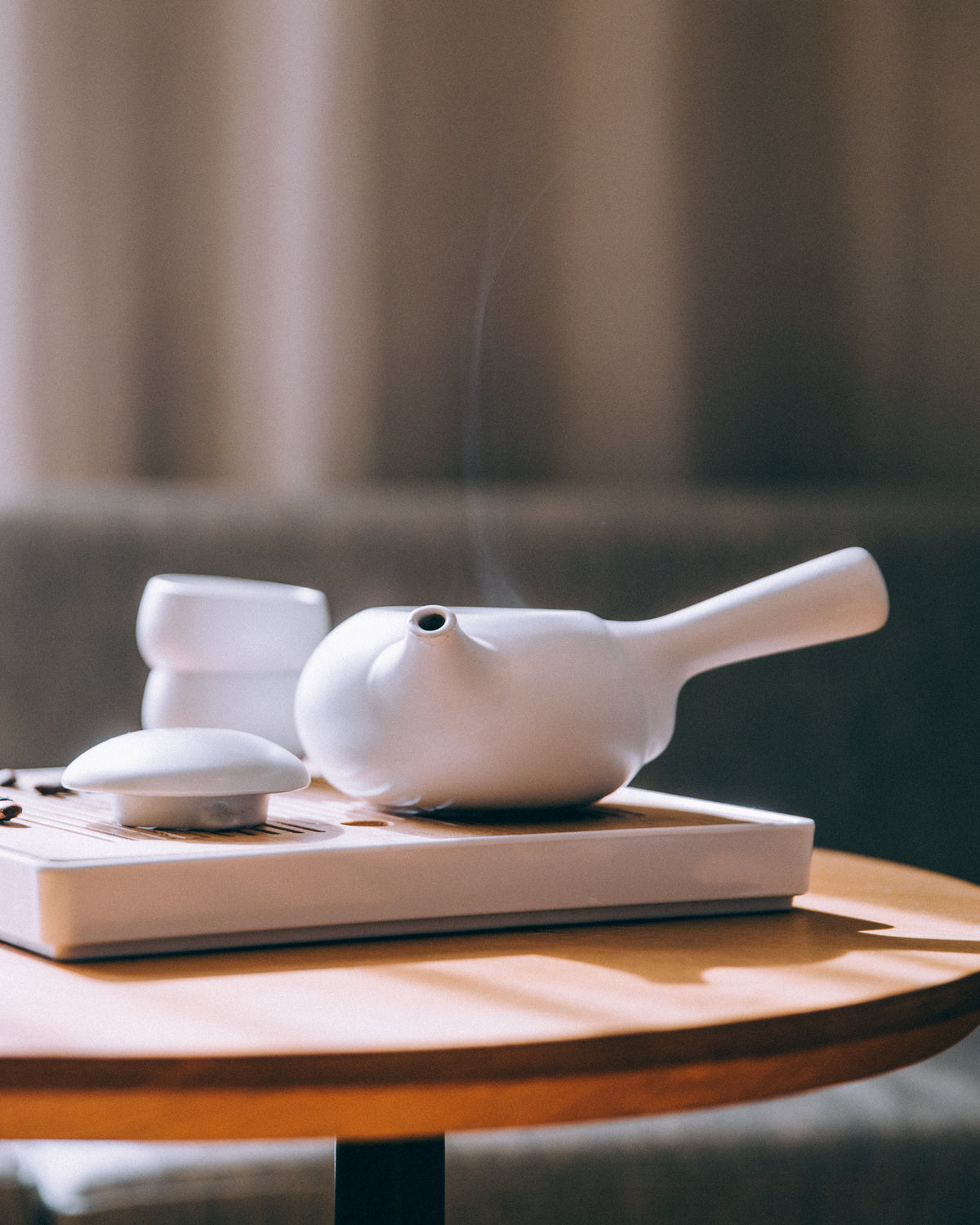
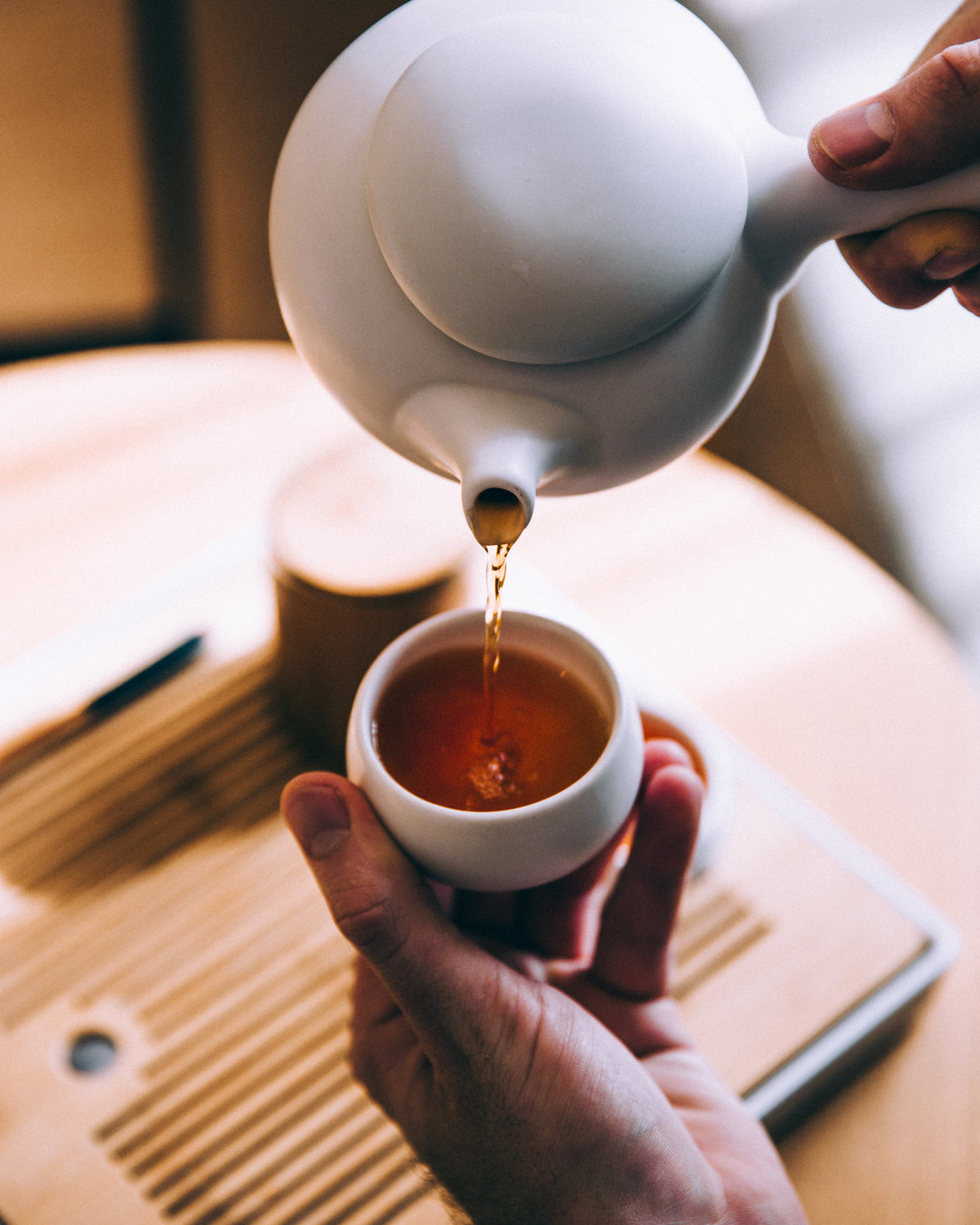
In the cup, young Sheng pulls floral first — orchid, dry sage, a green-mineral note that flickers on the tongue. The hui gan — the returning sweetness, after the swallow — is the cleanest of the three teas in our protocol. That’s where the brand name comes from. The cup finishes. Then the sweetness arrives. You feel it at the back of the throat thirty seconds later.

Why morning: the compressed-cake structure breaks open in steeping. The first 30-second steep delivers roughly a third of the available caffeine. Each subsequent steep adds incrementally. By the end of the session, you’ve drunk what your espresso would have given you in one minute — released across forty.

That is the difference between a spike and a session.

This is the tea that replaces the cup most people resent. Not the Saturday-morning espresso made with the kettle whistling. The Tuesday 7:14 a.m. cup, the one needed to write the deck. Sheng Pu-erh, gongfu-brewed at 90°C across five steeps, does that job. Without the 10 a.m. cliff.

Sheng alone is a good morning. With the midday Da Hong Pao and evening Shou Mei, it is a day.

The dose curve role

Why Does Sheng Earn The Morning?

A gongfu session of Sheng — 5g - 8g of leaf across five steeps at 90°C — delivers roughly 80–110 mg of caffeine per session, alongside a similar range of L-theanine. Lower than your espresso. Spread across forty minutes, not landed in one.

That curve is the morning role: above the attention threshold for ninety minutes instead of peaking and crashing. The L-theanine layer softens the edge — same engine, different suspension.

Steep five lands ninety minutes in, when the second-coffee thought would have started. There would not be one. There need not be one.

Over the course of the day, the protocol delivers 130-230 mg of caffeine in total - within the EFSA daily intake range, fractionated into three sessions that remain above the attention threshold without crossing into a crash.

CAFFEINE PER SESSION

~ 80 - 110 mg / session

Fractionated across the 5-steep session — released over ~40 minutes, not landed in one.

MORNING 06:00 –10:00 06 07 08 09 10 Attention Threshold

Brewing — the 5 steeps

How To Brew Sheng: 5 Steeps In Under 5 Minutes.

STEEP 1
15s
90°C
Floral arrival, dry sage edge.
STEEP 2
20s
90°C
Body builds, sweetness threads through.
STEEP 3
30s
90°C
Floral broadens, the hui gan returns sweet.
STEEP 4
45s
90°C
Body holds, finish stays long.
STEEP 5
75s
90°C
Sweet finish. Leaf still alive.

The dose curve role

What You’ll Taste.

FLORAL DRY SAGE Stonefruit SWEET FINISH LONG HUI GAN RETURN

The morning steeps lift floral with a dry-sage edge. Later steeps round to a long sweet finish — the hui gan return the brand is named for.

Choose your Path

Three Teas. One Day.

$13 less than buying separately

One-click cancel. No subscription trap.

Explore More

FAQ

Sheng Pu-erh - Questions.

Will this give me a stomach ache? It's young pu-erh.

Young raw Sheng is not fermented — fermented pu-erh is “shou,” which is a different tea entirely (see Q2). Sheng is unfired-and-aged: light, floral, low astringency when brewed at 90°C with the recommended 5g / 200ml ratio. If your stomach is sensitive on an empty stomach, eat a few bites of something before steep one and you will be fine. Heavy-stomach reaction is almost always either over-leafed brewing (too much leaf for the water) or shou pu-erh, not Sheng.

How is this different from shu (cooked) pu-erh?

Sheng (生) means raw. Sun-dried leaves, compressed, aged slowly — sometimes for decades. The cup is floral and bright when young, deeper as it ages. Shu (熟) means ripe — fast-fermented over 45–60 days in piles to mimic decades of natural aging. Earthy, woody, dark cup. Both are pu-erh; both come from Yunnan; both ferment over time. We sell young Sheng because it carries the morning protocol slot. Shu is a different tea for a different cup.

What does "Hui Gan" actually mean - and does this tea actually have it?

Hui gan (回甘) literally means “the returning sweetness.” It names a specific sensation in Chinese tea tasting: the cup finishes, then thirty seconds to a minute later, sweetness arrives at the back of the throat — not in the cup, in your body’s response to the cup. It happens with high-quality teas where the polyphenol structure is intact. Young Sheng is one of the cleanest expressions of it; aged whites and well-roasted oolongs also produce it. The brand is named for this sensation. You will feel it most clearly on steep three and after.

Can I age this further at home?

Yes. Store the unopened tin in a dry, ventilated space at room temperature, away from light and strong odors. Don’t refrigerate (humidity will damage the cake). Over the years, a young Sheng deepens — floral notes fade, sweetness rounds, the cup darkens. Five years is a meaningful shift. Twenty years is a different tea. We’ve sourced lots aged decades in proper storage.

Will it go bad?

Properly stored, no. Pu-erh is one of the few teas that actively improve with age. Avoid moisture, strong smells, and direct sunlight. An opened tin holds peak freshness for 6–12 months; after that, the cup softens but does not spoil.