Da Hong Pao 50g single tin (placeholder)

Da Hong Pao (岩) — 150g

$58.00
Sale price  $58.00 Regular price 

Midday • 11:00-15:00

Da Hong Pao

$58.00
Sale price  $58.00 Regular price 

Midday. Roasty. Mineral.

CAFFEINE
~ 60–90 mg / Session
Tin Size
150 g
Serving Size
5g / Session
Total Sessions
30
Origin
Wuyi
Elev.
~ 800 m / 2,600 feet
Curve role
Own Your Afternoon
Price per Session
$ 1.9
The midday tea of the Three-Tin Protocol. Single-tin is a refill path.
Da Hong Pao 50g single tin (placeholder)

Origin

From the Cliffs of Wuyi

Yiwu Mountain, Yunnan — Terraced Arbor Forest Above the Cloud Line.

Da Hong Pao means “Big Red Robe.” The story is Ming dynasty. A scholar passing through the Wuyi Mountains in Fujian fell ill on the road, was revived by tea brewed from six mother trees on a rock cliff, and on reaching the capital the next year, sent his ceremonial red robe back to drape over the bushes that had saved him. The trees are real — they still stand on Mount Wuyi, photographed and protected. Production from the originals stopped in 2005. Everything sold today comes from cuttings.

Wuyi is a UNESCO terrain — vertical rock faces, mineral soil, and fog that settles late into the morning. The grade designation that matters is Zhengyan, which translates literally as “true cliff” — tea grown on the rock terraces themselves, not on the lower-elevation flats that ring the mountain. Our lot is Zhengyan. The mineral character in the cup is the rock — leached through the leaf during growing, concentrated in the cup.

What separates a Da Hong Pao from any other oolong is the roast. After the leaves are partially oxidised and rolled, they go into bamboo baskets above pinewood charcoal at low heat for hours. Then they rest. Then they go back over the charcoal for another pass. The full cycle is repeated three to six times across months. Each pass deepens the flavour and reduces moisture. The roast level you taste in the cup is the master’s signature — too light and the cup is grassy; too heavy and it tastes scorched. The line between the two is held by hand.

This is a craft that takes forty years to learn. In Wuyi, charcoal roasting still moves between masters and apprentices the old way — the apprentice stays beside the pit through firing windows that can last fourteen hours straight, learning the pit’s voice.
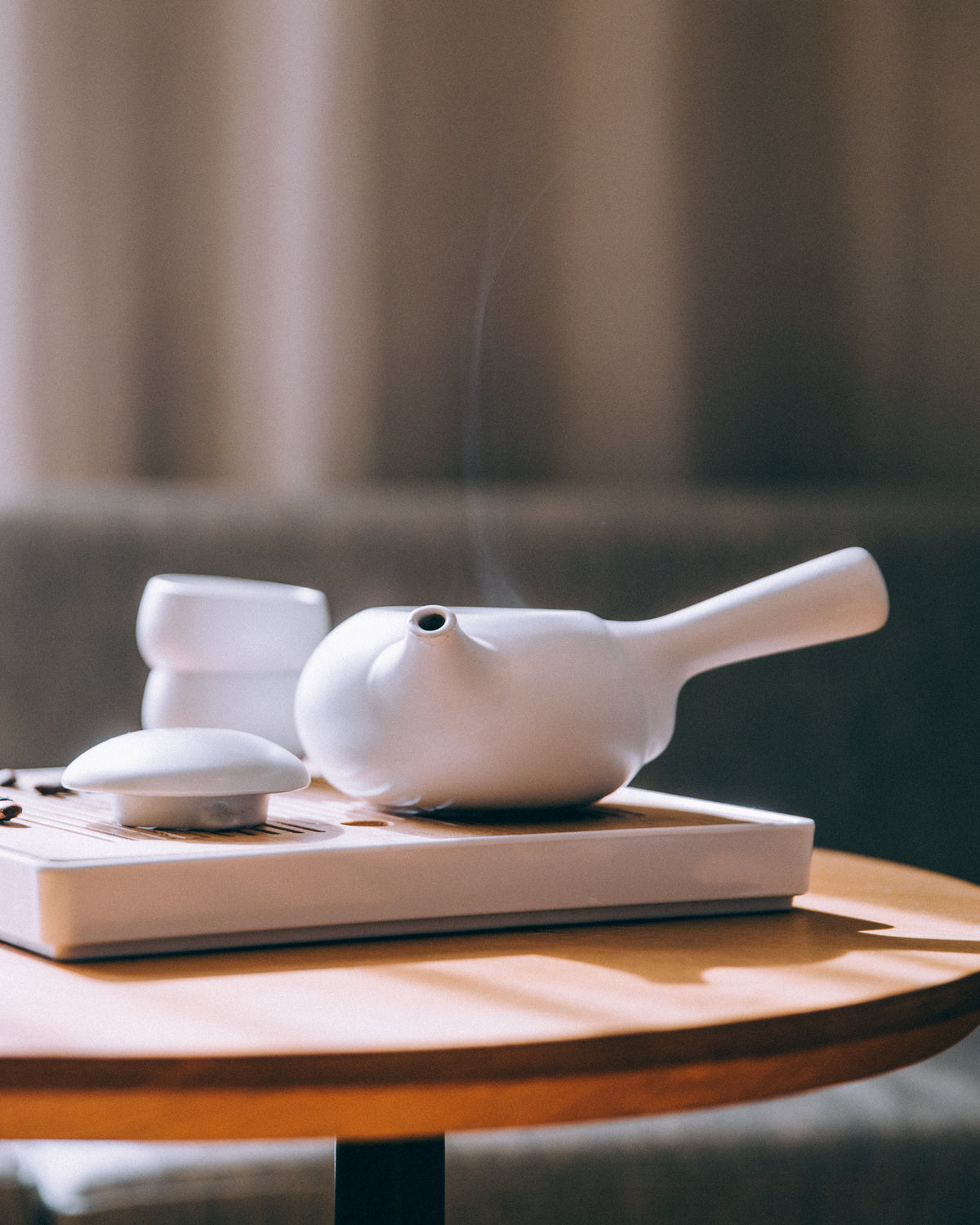
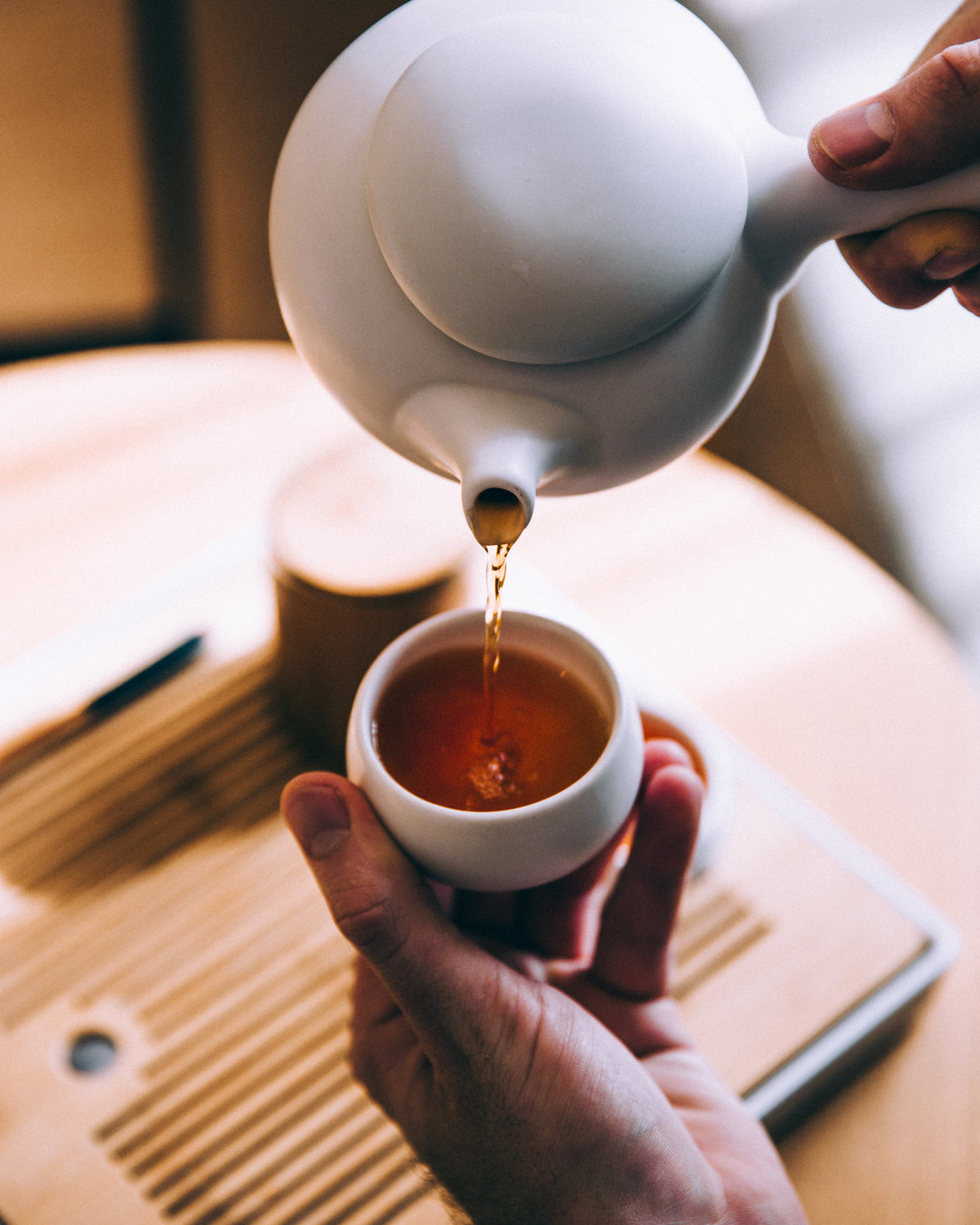
In the cup, you get the roast first — toasted nut, charcoal warmth, a baking-spice register that runs across the tongue. Underneath that, mineral. Underneath the mineral, stone fruit — longan, dried apricot, and sometimes cinnamon bark. Five steeps pull each layer out in sequence. The first steep is roast and stone. By the third steep, the mineral is louder. By steep five, the cup is sweet and quiet.

This is the midday tea. Caffeine still meaningful — the kind that lifts you out of the post-lunch trough without putting you back on the morning spike. The roast itself slows the cup down. The nose registers the warmth before the caffeine hits the brain. That pacing is the protocol working.

Sheng is the start of the day. Da Hong Pao is what carries it.

The dose curve role

Why Does Da Hong Pao Earn Midday?

By 1 p.m. the morning Sheng has cleared. The post-lunch trough is real — adenosine rebuilding, blood pooling to the gut, the cognitive dip that coffee culture solves with a second espresso and an afternoon spike. Da Hong Pao does the same job without the spike. A 5g gongfu session at 95°C across five steeps delivers roughly 40–55 mg of caffeine, fractionally. The roast itself slows the cup down — warmth registers in the nose before caffeine reaches the brain — giving the L-theanine a window to land first. By the time the caffeine cleanup is happening, the alpha-wave layer is already in place. You don’t bounce. You resume.

Across the day, the protocol delivers 130–230 mg of caffeine total — within the EFSA daily-intake range, fractionated into three sessions that hold above attention threshold without crossing into crash.

CAFFEINE PER SESSION

~ 60 - 90 mg / session

Fractionated across the 5-steep session — released over ~40 minutes, not landed in one.

Midday 11:00 –15:00 11 12 13 14 15 Attention Threshold

Brewing — the 5 steeps

How to Brew Da Hong Pao: 5 Steeps in Under 5 minutes.

STEEP 1
12s
95°C
Roast lifts, mineral base.
STEEP 2
18s
95°C
Mineral deepens, stone-fruit appears.
STEEP 3
30s
95°C
Full roast structure, peach-pit clarity.
STEEP 4
45s
95°C
Tail lengthens, mineral persists.
STEEP 5
75s
90°C
Slow decline, full balance.

The dose curve role

What You’ll Taste.

Roasty Mineral Stonefruit Toasted Long Tail

Charcoal roast structures the cup; mineral terroir lengthens the finish. Stone-fruit appears in steeps 2–3 — peach and apricot pit, not jam. By the final steep, the roast clears, and what’s left is sweet, quiet, long.

Choose your Path

Three Teas. One Day.

$13 less than buying separately

One-click cancel. No subscription trap.

Explore More

FAQ

Da Hong Pao - Questions.

What does roasted oolong actually taste like? Is it like coffee?

Toasted nut and charcoal warmth first. Mineral underneath. Stone fruit — longan, dried apricot, sometimes cinnamon bark — through the middle steeps. By the fifth steep, the roast clears, and what is left is sweet and quiet. It is not a bitter cup. It is not a smoky cup. It is not coffee — coffee is dark roasted beans extracted under pressure; Da Hong Pao is partially oxidised leaf, charcoal-fired in passes across months. The roast is the seasoning, not the food.

Is this the same as the famous "first three bushes" Da Hong Pao?

No, and any tea sold at consumer scale that claims to be is misrepresenting. Production from the original six (sometimes described as three) mother bushes on the Wuyi rock face stopped in 2005, by government decree, to protect the trees. The Da Hong Pao sold today — including ours — comes from cuttings of those trees, propagated and grown on the same Wuyi terroir. The genetic line is the same; the lineage to “first three bushes” is preserved through cultivation, not direct picking. Our lot is Zhengyan-grade from this propagated line.

Can I age this further at home?

Yes. The Da Hong Pao is a Wuyi rock oolong, finished over charcoal. That roast is what lets it keep. Roasted rock tea is one of the few teas built to sit for years and grow rounder, not flatter — the edge softens, the finish gets deeper.

If you want to age it: leave it in the tin, sealed, somewhere cool and dark. No fridge. No sunny shelf. Keep it away from anything with a smell — spices, coffee, a cupboard that holds both. That's the whole method.

But you don't have to wait. This tin is roasted, rested, and ready to drink today. Aging is a choice, not a repair. Brew it now, or set a tin aside and open it next year. Both are right.

Will it go bad?

Not the way milk goes bad. Dry tea doesn't spoil. Kept sealed and dry, these leaves stay good for years.

What tea can do is go dull, and two things cause it: moisture and smell. Damp air flattens the roast. Open air lets the leaf pull in whatever's nearby — onions, soap, last week's garlic. The fix covers both: close the tin, keep it dry, and keep it clear of strong smells.

The tin does most of this for you. It seals, it blocks light, it doesn't breathe. Scoop what you need, press the lid back, and the rest waits for you — same as the day it shipped.