Aged Shou Mei 50g single tin (placeholder)

Aged Shou Mei (老) — 150g

$36.00
Sale price  $36.00 Regular price 

Evening • 15:00-20:00

Aged Shou Mei

$36.00
Sale price  $36.00 Regular price 

Mellow. Dates. Honey. Dried Apricot.

CAFFEINE
~ 15–30 mg / Session
Tin Size
150 g
Serving Size
5g / Session
Total Sessions
30
Origin
Fuding
ELEV.
~ 600 m / 2,000 feet
Curve role
Wind Down
Price per Session
$ 1.2
Aged Shou Mei is the afternoon, the curtain call of the three-tea day.
Aged Shou Mei 50g single tin (placeholder)

Origin

Aged On The Fujian Coast

Aged-Storage Warehouse, Fuding, Controlled Humidity.

Shou Mei is white tea. The category and the processing are the simplest in Chinese tea leaves picked in late spring, wilted in the sun, never fired, never rolled. The cup that comes out of those leaves on day one is grassy and bright; the cup that comes out of those leaves five years later is honey and quiet. That arc — what aging does to a white tea — is what this tin is.

Our lot is from Fuding, in northern Fujian, where the coast brings ocean humidity, and the climate holds a steady late-spring window each year. “Shou Mei” — sometimes translated as “longevity eyebrow” — names the larger-leaf grade harvested later in the spring, after the tippy buds (Bai Hao Yinzhen) and the smaller leaves (Bai Mudan) have already been picked. Larger leaves. More body. More capacity to age.

Aged white tea isn’t a marketing claim. It’s a category. In Fujian, the saying is: one year tea, three year medicine, seven year treasure. The compounds in the leaf change slowly across years — chlorophyll fades, polyphenols polymerise into theabrownin, the cup darkens from straw to amber, the taste mellows from grass to dried apricot and beeswax.

For generations in Fujian, aged white was the household afternoon and evening tea. Easy on the stomach. Low stimulation compared to roasted oolongs or pu-erh. Often served to elderly relatives or to a guest after a heavy meal. The cup is mellow enough that you can drink it at six in the evening and still sleep at ten.
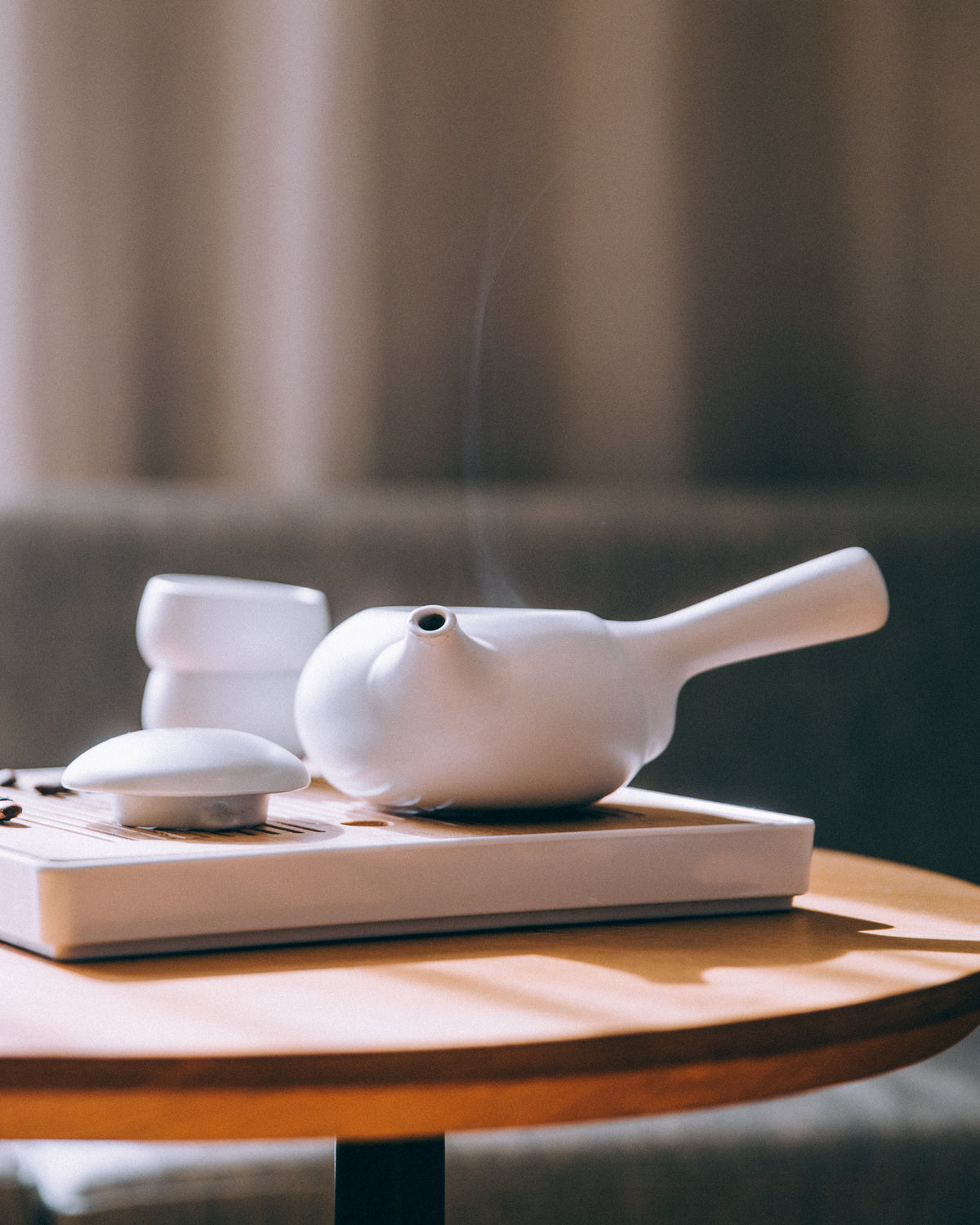
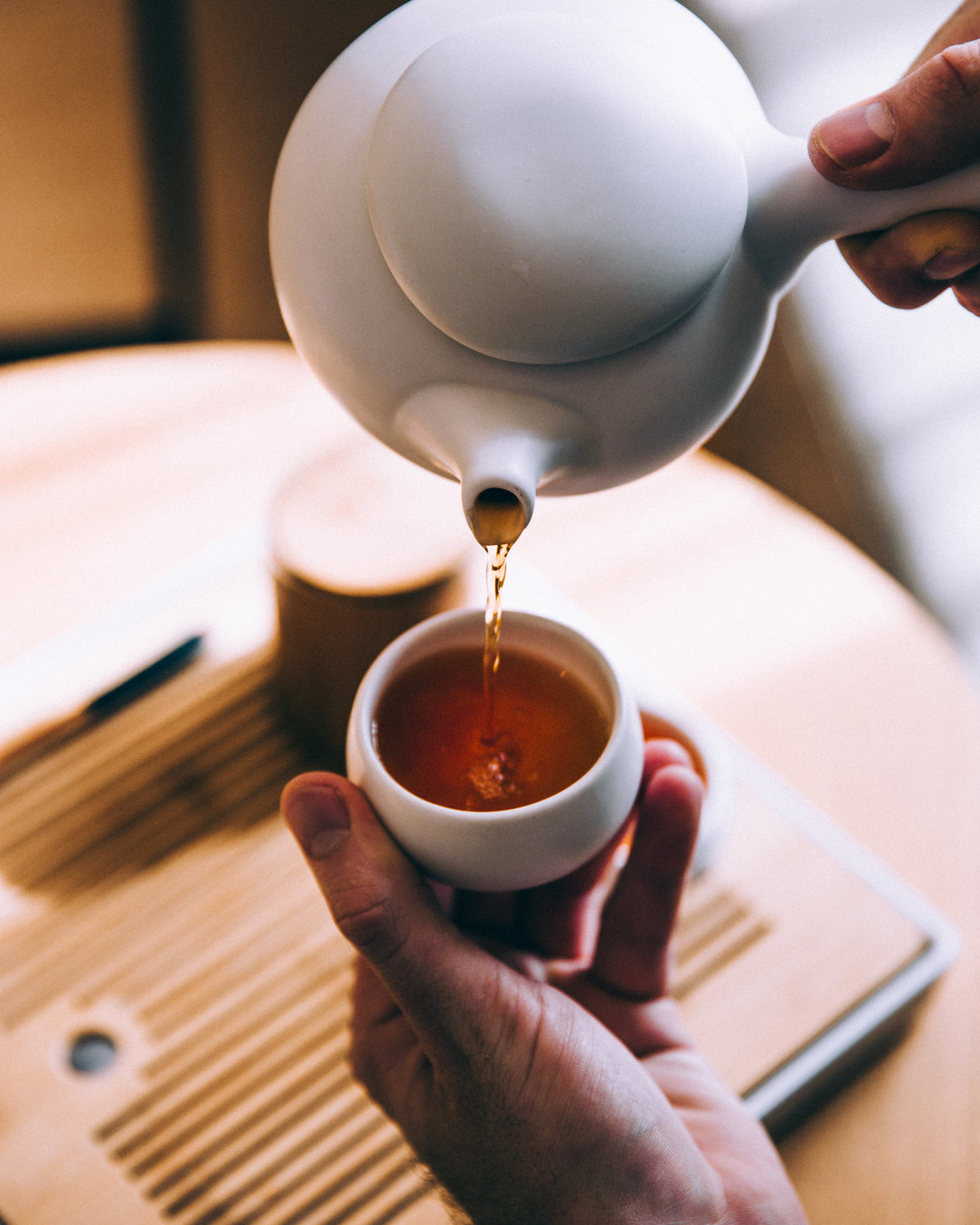
In the cup, the first steep is mostly honey and hay — soft, sweet, no edge. The second steep deepens into dried apricot and a faint warmth of beeswax. By the fifth steep, the leaf has given everything; the cup is pale gold and quiet. No roast register. No mineral edge. No astringency. Just sweetness that lingers.

Why evening: caffeine present but minimal (at ~ 15-30 mg)— enough to take the edge off the 4 p.m. dip without buying back another night of bad sleep.

Sheng wakes you. Da Hong Pao carries you. Shou Mei lets you finish.

The dose curve role

Why Does Aged Shou Mei Earn The Evening?

The evening problem isn’t caffeine — it’s a habit. By 4 p.m., most workers reach for a fourth cup, not from pharmacological tiredness but from a wired-in ritual: “I need a hit to finish.” That fourth cup finishes the workday and starts the bad night.

Aged Shou Mei replaces the ritual without buying back the sleep cost.

We estimate ~15–30 mg of caffeine per session — roughly a fifth of what your espresso delivers at 8 a.m. The aged leaf mellows the cup but preserves the L-theanine layer. You finish the day calm enough to close the laptop, not wired enough to scroll till midnight.

Across the day, the protocol delivers 130–230 mg of caffeine total — within the EFSA daily-intake range, fractionated into three sessions.

CAFFEINE PER SESSION

~ 15 - 30 mg / session

Fractionated across the 5-steep session — released over ~40 minutes, not landed in one.

EVENING 15:00 – 20:00 15 16 17 18 19 20 Attention Threshold

Brewing — the 5 steeps

How To Brew Aged Shou Mei: 5 Steeps In Under 5 Minutes.

STEEP 1
20s
90°C
Honey opens, light apricot.
STEEP 2
25s
90°C
Mellower, deeper honey.
STEEP 3
60s
90°C
Rich amber, dried-fruit complexity.
STEEP 4
60s
90°C
Aged depth. Leather notes.
STEEP 5
90s
90°C
Final round. Mellow close.

The dose curve role

What You’ll Taste.

Mellow Honey Dired Apricot Aged Depth Soft

Aging mellows the white-tea base into honey and dried apricot. The depth builds slowly across steeps — softer than young white, fuller than typical aged white. The fifth steep ends pale gold and quiet.

Choose your Path

Three Teas. One Day.

$13 less than buying separately

One-click cancel. No subscription trap.

Explore More

FAQ

Aged Shou Mei - Questions.

Why aged? What does aging do to white tea?

For most teas, fresher is better. For white tea, aging is the category. Chlorophyll fades. Polyphenols polymerise into theabrownin. The cup darkens from straw to amber. The taste mellows from grass to dried apricot and beeswax. A five-year-old Shou Mei is a different cup from a fresh one — the way a five-year-old bottle of wine is a different drink than a new one. We sell aged because the evening protocol slot calls for it. The Fujian saying is: one year tea, three year medicine, seven year treasure.

How does aged Shou Mei differ from young white tea?

Young Shou Mei is grassy, vegetal, lightly sweet — closer to a soft green tea than to most categories. Aged Shou Mei is honey, beeswax, dried apricot, sometimes a faint herbal note that develops between years three and five. The leaves look different too: young leaves are silvery-green; aged leaves shift toward brown-amber. Same source, different category outcomes — driven by storage time, not processing differences.

Can I drink this if I'm sensitive to caffeine in general?

For most caffeine-sensitive readers, yes — 12–18 mg per session is roughly a sixth of an espresso. If you are very sensitive (e.g. you cannot drink half a cup of green tea past noon without sleep disruption), treat this as a 3–4 p.m. cup rather than a post-dinner one. We do not recommend drinking it within three hours of intended sleep if you are highly sensitive.

Does the flavor keep changing as it ages?

Yes. Aged white tea is a slow-moving cup. Year three: drier honey, lighter body. Year five (our current lot): honey-apricot, beeswax, full body. Year seven and beyond: deeper amber, more medicinal sweetness, sometimes a camphor-adjacent note. If you store an unopened tin in a dry, ventilated space, the cup you drink in 2031 will be different from the cup you drink today. Both will be good. They will not be the same.